5 components of an AI strategy, today
Jul 21, 2026

This past week, the Idaho Business Review published a piece about how our company is helping local businesses in Idaho find value in data and AI. In it, Jet Hansen and I discuss at length our opinions about the human–AI dance. Our conviction in getting the best out of the people and the technology might sound trite to you, the reader.
Especially in light of the broader, heated debate about impending job disruption.
But what we shared was genuine, and I can attest: of all the automation-esque AI products we’ve deployed in the past two years, none have been perceived as a threat to job security. In fact, each quenched latent demand for tech intervention inside companies. Specifically, each project first made it onto the shortlist because someone said, “I’ve always wanted to ___.”
And for the foreseeable future, I would bet this to be the nature of nearly all Operations projects coming through buildAidaho: the backlog that no vendor solution ever made sense for (too custom, too expensive, too slow, too hard to maintain).
Why were these items on the wishlist to begin with? Likely because they’re tasks undifferentiated by human skill or creativity.
Exporting the same csv of stats for the weekly report; scheduling calendar invites for closing timelines; inputting invoices into the company’s accounting system. The reason, in part, that we are some distance away from seeing significant job disruption at the local level due to AI, is that we have years’-worth of projects still to work through.¹
This provides us a runway. Because there will likely be real implications eventually, it’s worth it for leaders to begin planning now. Through working at the frontlines of AI adoption, we've started to see five themes routinely emerging for leaders attempting to develop an “AI Strategy.”
(1) It's better to constrain, then expand
By my estimation, a considerable portion of the “lack of ROI of AI” can be attributed to companies taking the approach of “expand, then constrain.” The magical experience of seeing AI complete a particular task immediately unleashes the creative juices in just about everyone (recall the backlog mentioned above). These single, isolated moments encourage a quick progression to using AI for everything. Or sometimes, being told to use AI for everything. And in the classic misstep of “I have a hammer, therefore everything is a nail,” companies find themselves applying AI to everything, then contending with poor quality, inconsistent output, and very expensive new opex.
Conversely, when you constrain, then expand, your AI workflows tend to be deeper, more P&L-aligned, and focused on real problems. In all cases, I think exercising constraint means asking oneself: does this contribute to the core functions, capabilities, or competitive advantages of our business? Once the thinking is aligned to the business, constraints might look like: limiting time or budget resources, capping the number of vendor tools, or setting a minimum number of departments a given project impacts.
In a world of abundance, and a dropping barrier to entry with technology, edges can be carved by those who build a focus muscle.
(2) Understand how your employees’ roles are distributed across Boston Consulting Group's (BCG) Labor Disruption Segments
Even among top forecasters, the projections of AI’s impact on jobs have large uncertainty bounds. Rather than focusing on exactly the number, I think it’s more helpful to take an earnest look at how each role is impacted. More specifically, how will AI reshape the everyday mix of tasks, and how does the market react to that changing mix?
BCG divides jobs along these two axes, with a critical focus on the estimated 43 percent of jobs that are projected to have “high levels of task automation.” Pictured in the green blocks, you see the estimated percentage share of total jobs that fall into each category:
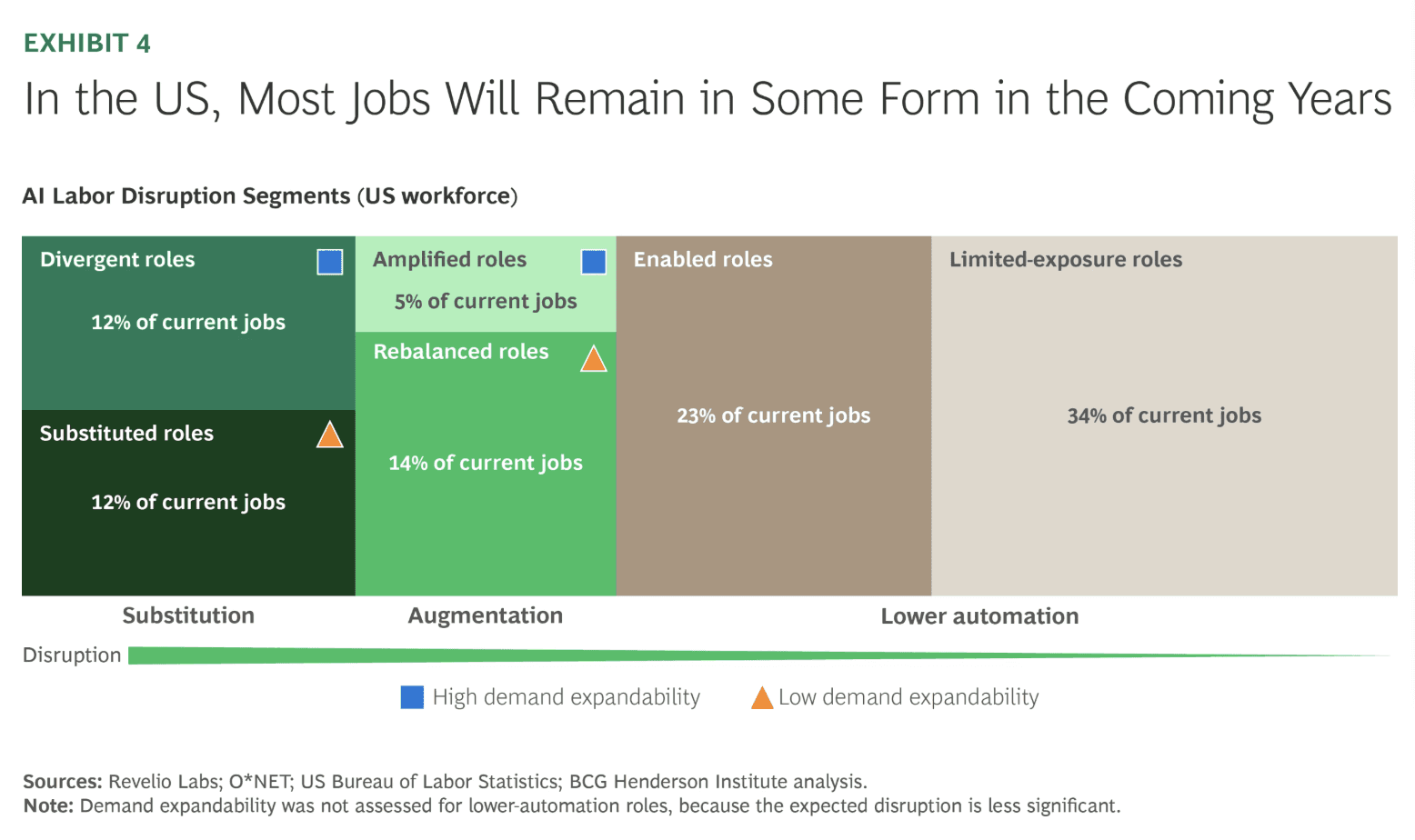
Amplified roles will be those where AI contributes significantly to execution tasks, reallocating human labor to systems-design, or generally more complex thinking. Skilled workers retain strategic direction over architectures and orchestration, but are complemented by extraordinarily fast execution from AI augmentation. Overall market demand for these roles may stay the same or even grow.
Conversely, divergent roles are those for which AI can do most tasks, and companies capitalize on this by expanding serviceable markets, not headcount. In this situation, AI’s contribution to the work means serving more customers with fewer resources. Entry-level positions decline, though overall business may grow.
For these 12% of current jobs, leaders will need to find a way to foster a growth pipeline (“upskilling”) towards senior roles, despite having less entry-level training ground.
Substituted roles are those for which AI can replace core tasks, and overall demand for these jobs is capped. These roles, even before AI, were likely cited as those with little upward growth potential. They are particularly vulnerable because for some structural reason, efficiency gains do not encourage either a) higher-skilled tasks or b) expanded market opportunities.
Most management advice would say that leaders should have always paid attention to career paths with low ceilings. And now, AI is forcing leaders’ hands into re-imagining those roles more immediately.
Rebalanced roles, the final high-impact category, are those for which overall demand is bounded, and the mix of tasks changes significantly. Researchers of all kinds are good candidates for rebalancing. Even with newfound capabilities, it’s unlikely that we’ll need significantly more Idaho Fish and Game Biologists, for example. However, the breadth of their studies could grow significantly. Instead of studying one species or one stage of a lifecycle, with the help of AI-augmentation, the biologists could expand their research breadth while maintaining rigorous depth.
I will say, it’s not immediately obvious to me which jobs fall into which category, and for how long a given classification is valid before it needs reassessed against the changing landscape.
Moreover, the story of AI adoption is mostly unwritten; it’s unclear how integrated this technology will become. Government intervention for the software providers, community outcries against data centers, and the reality of slow evolutions at the individual level all could stifle AI’s potential to impact jobs in this six-quadrant way.
The exercise feels important, nonetheless, because it gives leaders a useful framework for imagining how different roles may evolve in the future.
(3) Develop distinctive data
Absent structural or regulatory barriers, AI integration will be a solved problem. We’re already seeing it – nearly every saas tool you’re subscribed to has AI features already integrated. In the future, you cannot use AI in a differentiated way if you don’t have differentiated data.
People used to say “data is the new gold,” and it has never been more true than today.
(4) Know your spend; know your exposure
How dependent are your operations on one model provider? On AI tools as a whole?
In a recent KPMG survey of 2,000+ business leaders, 42% reported only having partial visibility into AI spending. This is compounded by complicated forms of usage-based pricing, and introductory subscription pricing currently sitting below actual cost (i.e. AI subscriptions will cost more in the future, once they’ve embedded on critical-path workflows). This visibility is deceptively difficult to achieve when AI is natively available in apps (but charged separately), subscriptions to ChatGPT or Claude vary across teams, and production-services have token-based spend.
When it comes to mastering your exposure, it’s two-fold. First, one of the frontier labs significantly increases prices, can you switch vendors? And second, for AI models serving production traffic, can you switch models for any reason: quality, cost, availability, latency, fitness for task?
In each instance, higher dependency means higher exposure.
(5) Roadmap the progression from vibe-coded to production
In the last two weeks, I’ve confronted this two times. First, a department head of one of our clients wants to contribute to the codebase. These “citizen development” situations are so unique because the users know their domains so well. They have clear visions of how something could be solved. However, they have so little experience with programming, that their design choices, code quality, and scalability are poor. It’s never been easier to get to an 80% solution. But when something is vibe coded, the last mile to Production is incredibly long.
And then there’s the security aspect – my second example. A new client encouraged using vibe-coded projects on real business processes, only to find out internal data was leaked externally.
For these two reasons, establishing a repeatable path to get from vibed-to-deployed is a worthwhile exercise. Some helpful structures include handoff points, strict Claude Code guardrails, a clear bifurcation of roles, and a designated sandbox environment.
This is a work in progress for us.
AI’s pervasiveness requires attention from everyone.
And though I feel strongly that the consequences are less urgent than the news portrays, there is a reason to thoughtfully consider how it will impact your business’ – your people’s – futures.
Tackling these 5 themes helps establish a clear-eyed AI strategy, and the culture you foster will drive your people strategy. Taken together, we wield agency over the future, and that leaves me feeling pretty optimistic.
¹ I will make two concessions: one for job disruption that came as a result of overzealous leaders who laid off early and are now rehiring in many cases. And a second for leaders using AI as a scapegoat for poor people planning and financial management.